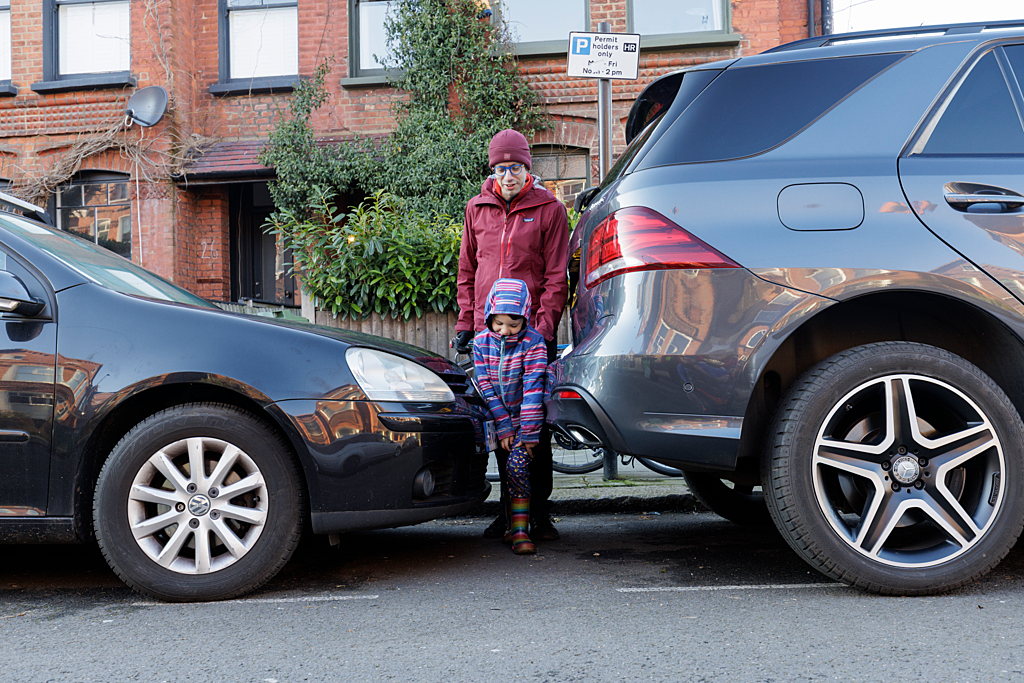
Our new report ‘Ahead of the Kerb’ examines the hidden costs of parking in Scotland – including the pressures created by SUVs – and sets out how to use parking reform to reclaim street space, improve safety and make our cities work better for people.
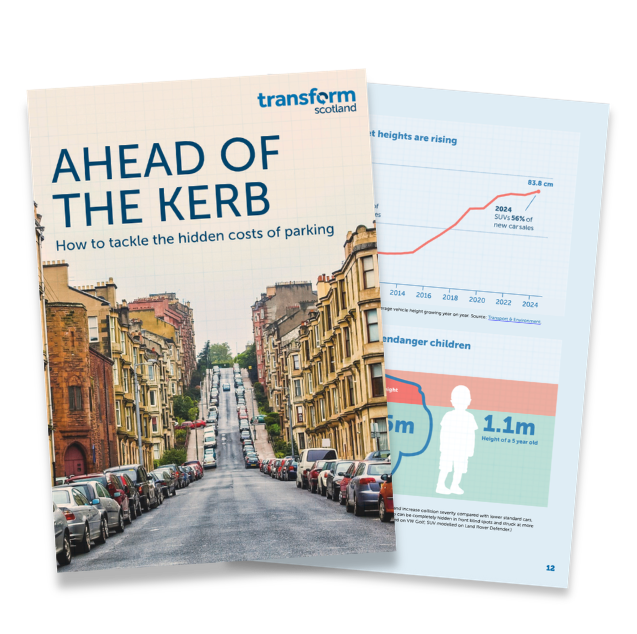
Published today (Tuesday 21 April), Ahead of the Kerb highlights how parking policy has struggled to keep pace with private vehicle use. With SUVs now making up more than half of new car sales, cities are seeing increasing pressure on limited kerb space, alongside growing concerns about visibility, pedestrian safety and the everyday usability of streets.
The report draws on engagement with officers across Scottish city councils, as well as public opinion research, to understand how parking is being managed on the ground. It finds that while parking is often discussed in terms of convenience, it is in practice a key policy lever shaping transport choices, health outcomes and the quality of public space.
A fairness issue
In addition to its impacts on road damage, public health, climate, and safety, parking policy is a key fairness issue – and raises questions of how we use limited street space. In Scotland, 1 in 4 have no access to a car (rising to 66% for low-income households), yet large areas of valuable urban space are still set aside for parking.
Report author Laura Hyde-White notes, “access to a car is far from universal, yet public space is increasingly shaped around vehicles that many people neither use nor benefit from.”
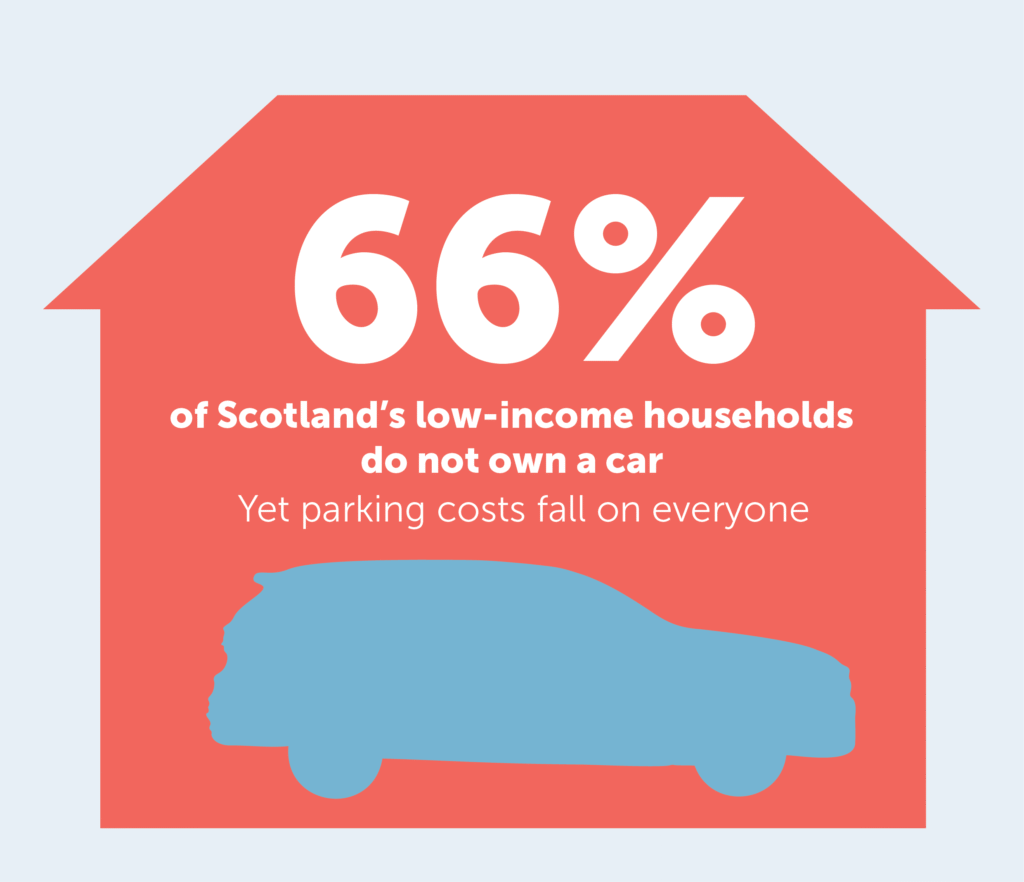
When parking is treated as the default use of kerbspace, it can limit other priorities – from safer walking and cycling routes to greener, more accessible public places. The result is a system where the costs of space allocation are shared by everyone, but the benefits are not.
A spotlight on SUVs
A central theme is the need for parking policy to respond to the rise in larger vehicles. These vehicles exacerbate parking challenges – taking up more space, causing more damage and posing more risks to pedestrian safety.
The report also highlights growing support for reform. On-street surveys conducted by Transform Scotland shows strong concern about the impact of larger vehicles in urban areas, alongside support for measures such as higher parking charges for heavier cars and stronger action to manage street space more fairly.


Parking policy expert Sue Flack said:
“Parking policy is critical to ensuring our cities prioritise people over vehicles. We have seen strong examples of progress, from pavement parking bans to emissions-based permits, but there is more to do.
“While approaches vary, there is a clear appetite among officers to use parking policy more strategically, but also a recognition that it is often constrained by legacy systems and political sensitivity.”
What are the recommendations?
The report sets out a package of recommendations for both local and national government, including weight-based parking charges, standalone parking strategies in all local authorities, and stronger support from national government to help councils deliver more progressive approaches.
Firstly, for Local Authorities:
(1) Enforce the pavement parking ban
This is a particular problem for disabled people, parents with pushchairs and young people who are forced to walk on the road. Those Local Authorities who have so far failed to implement the ban should now do so, to protect pedestrians and prevent damage that drivers cause to pavements.
(2) Adopt standalone parking plans
All 32 Local Authorities should develop dedicated parking plans setting out how parking will be managed across their areas – linking restrictions, pricing, and permits to national objectives such as modal shift.
(3) Engage major employers on workplace parking
Proactive collaboration between Local Authorities and large trip-generators (e.g. universities, hospitals, other major employers) should be taken forward in order to identify opportunities to reduce car commuting and promote healthier alternatives.
(4) Implement kerbside management strategies
Local Authorities should build upon the Lambeth model to rebalance kerbspace to prioritise shared uses (e.g. cycle parking, delivery bays, and community space).
(5) Introduce weight-based parking charges
Parking plans for Scotland’s cities should apply higher fees for heavier vehicles, starting with residential permits, following the precedent set by Glasgow and Edinburgh’s CO₂ permit schemes to shift behaviour toward smaller, cleaner cars.
(6) Ban SUV advertising
Prohibit SUV advertising on all council-owned sites, taking the City of Edinburgh Council’s ban as a model.
Secondly, for Scottish Government:
(1) Equip Local Authorities to make the case for reform
The Scottish Government should provide guidance and research-based materials to help councils communicate the benefits of revised parking policies – including the hidden costs for public space, health, equity, and public finances.
(2) Advocate for a levy on bigger cars
Scottish Ministers should actively press the UK Government to introduce a flat, progressive Large Vehicle Levy on vehicles above 1,600 kg (2,000 kg for EVs), applied through Vehicle Excise Duty. This would reflect the disproportionate impact of large vehicles on our streets.
(3) Explore the feasibility of banning SUVs in city centres
Restricting the unnecessary use of the largest private vehicles in cities, often built for off-road conditions, would reduce road damage, free up public space, and improve street safety
Read the report in full here.
Support our work on ending big car bloat

This Earth Week, we’re launching a fundraising campaign for the first time in years to support our work on the rise of SUVs in Scotland’s cities.
We’re working with councils, communities and decision-makers to address the impacts of oversized vehicles on our streets.
We’re inviting supporters to donate during our Big Give campaign week, from Wednesday 22 to Tuesday 28 April. All donations made during this period are match-funded, meaning they go twice as far.
Find out more on the Big Give site here.