This International Women’s Day, policy officer Laura Hyde-White reflects on the role of transport in the lives of women and asks ‘Who benefits from our transport systems, and who is left behind?’.
Gender is a pivotal factor influencing journey choices yet it remains largely absent in transport planning
Transport is often viewed as a neutral service, a means to get from point A to point B. Yet in reality our journey choices are influenced by a complex web of social factors operating beneath the surface, not least the role of gender in shaping travel patterns, access and experiences.
As we celebrate International Women’s Day, we must hold a magnifying glass up to the inequalities embedded in our transport system. That is, how gender inequality intersects with transport and why a sustainable transport network is a gender-inclusive one.
Shorter, local and multi-stop: Women’s travel patterns overlooked
Women’s travel patterns are distinct, often characterised by more frequent, short trips throughout the day. This is especially true for those of us tied to caring responsibilities – from travelling to work and running errands to taking children to school or a relative to the doctors. In contrast, men typically undertake fewer but longer journeys during peak hours.
However, existing transport systems primarily prioritise radial planning focused on peak hour commutes into city centres, reflecting historical commuting patterns tailored to male breadwinners.
“Existing transport systems primarily prioritise radial planning focused on peak hour commutes into city centres, reflecting historical commuting patterns tailored to male breadwinners.”
As a direct consequence, transport networks don’t meet the needs of women and other marginalised groups who are more likely to take shorter, local and multi-stop journeys.
Additional barriers: Safety and accessibility
Safety concerns and accessibility barriers further impede women’s access to sustainable transport. From harassment on public transport to inadequate infrastructure, these challenges deter many women, particularly those with disabilities, from using public transport.
The Scottish Government has acknowledged the gendered experience of safety on public transport, having published a report in collaboration with women and girls ]across Scotland in March 2023. However, we are yet to see any follow up work on this topic.
Gender and poverty: Transport at the intersection
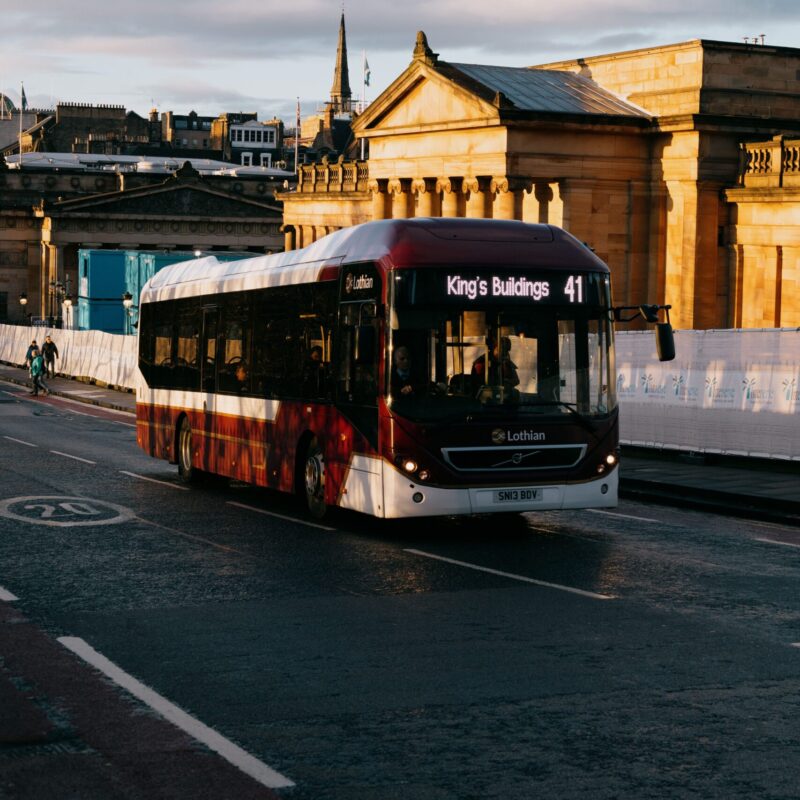
Women’s disproportionate burden of care work, coupled with lower incomes and employment opportunities, results in more disparities in transport usage. In particular, given that women are more likely to live on lower incomes, they disproportionately rely on walking and buses to get around.
“Extensive cuts to bus services disproportionately impact women and widen social inequalities.”
This means under-investment in public transport – specifically local bus services – disproportionately impacts women and their ability to participate in public life. Scotland has seen a 38% decline in local bus routes and it is extensive cuts to services like these which widen social inequalities and undermine the Scottish Government’s ambition to tackle poverty.

Transport as a social issue: Putting people first
Gender disparities and other inequalities (re)enforced by transport systems are the product of the default ‘technocratic lens’ adopted in transport decision-making. That is, ‘technical’ issues (e.g. engineering, technology, logistics) are prioritised over ‘social’ issues (e.g. gender, disability, inclusion).
As a result, top-down technology-led solutions are often favoured – see, for instance, the push for innovation in sustainable aviation fuels or electric cars – in favour of support for modal shift to public transport and active travel.
Imbalance in the industry
In light of the technical lens applied to transport, the sector is typically categorised within the fields of STEM (science, technology, engineering and mathematics) and economics. Given that these are male-dominated fields (only 5% of women working in STEM occupations compared to 28% of men), gender imbalance is perpetuated within the industry.
“To meet the transport needs of women and other marginalised groups, the sector must diversify.”
To meet the transport needs of women and other marginalised groups, the sector must diversify to include more expertise on and experience with gender issues and social inclusion.
Currently, 3 in 4 heads of transport bodies are men and although women have begun to fill key roles in transport in recent years, we’re still suffering from decades of under-representation in key decision-making roles in the industry.
Where do we go from here?
We know that a transition to sustainable transport is crucial to tackling the climate emergency – but we cannot expect to see increased public transport use if transport planning continues to fail to meet the needs of all members of society.
Steps towards a fairer and more inclusive transport system include:
- Collecting gender-disaggregated data: Comprehensive data collection is essential for identifying and addressing gender disparities in transport.
- Strengthening & supporting bus networks: Investing in bus services enhances accessibility and connectivity, particularly in underserved communities.
- Improving safety & accessibility of public transport: To make women’s journeys easier and safer, especially for those with disabilities.
- Diversifying the transport sector: Promoting diversity and inclusion within the industry is crucial for fostering innovation and addressing the diverse needs of transport users.
Overall, we must recognise that transport is inherently intertwined with issues of gender inequality. By prioritising inclusivity and actively challenging existing biases, we can build transport systems that serve as catalysts for social equity and empowerment – for a future that is not only sustainable but fair for all.