Public affairs manager Laura Hyde-White takes a look at today’s draft Scottish Budget, outlining Transform’s initial thoughts on the general trends in transport expenditure, as well as on one of the more eye-catching announcements: the introduction of a private jet tax.
Private jets: a welcome step in the right direction
One significant announcement in Shona Robinson’s unveiling of the 2026-27 Budget in Parliament today was the introduction of a private jet tax.
We’re pleased to see this move on fairness. The tax targets the most polluting form of travel, and sees the Government finally using its devolved aviation tax powers (after sitting on them for almost a decade).
But this must be the start – not the end – of aviation tax reform.

We now need the government to build on this move towards fairer pricing for the most polluting mode of transport by tackling frequent flyers and reducing short-hop routes. Why, for instance, are we seeing 120 planes flying between Edinburgh/Glasgow and London each day? If we’re serious about cutting climate emissions, we need financial incentives to curb these excessive flights which can easily be taken by train.
Increased cash for bus and active travel
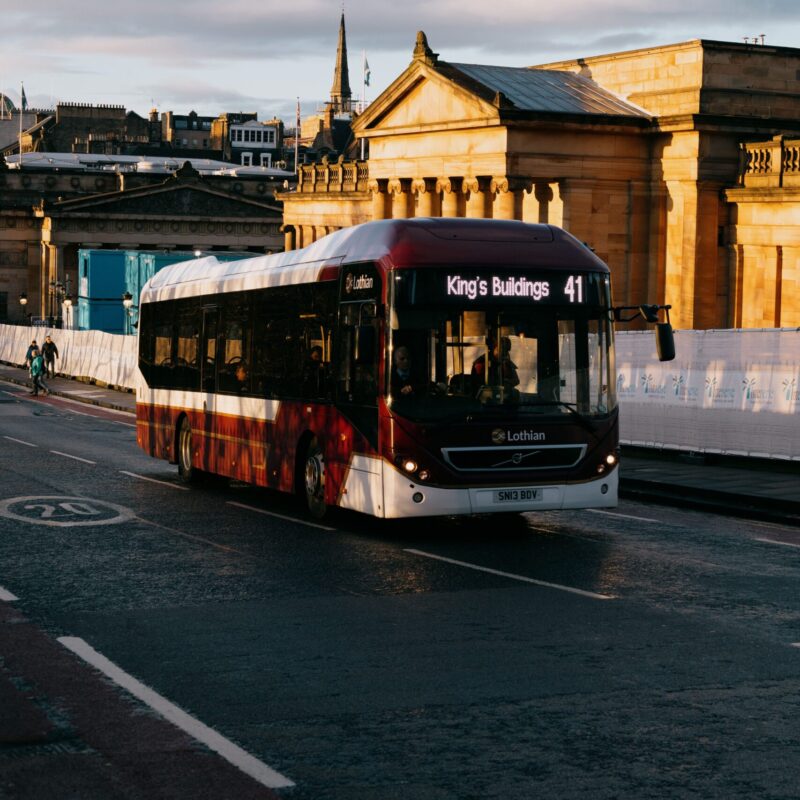
Other good news includes an increase in funding for the ‘Support for Active & Sustainable Travel’ budget line. This includes infrastructure investment for walking, cycling and buses.
We understand that there will be a large increase in the value of the Bus Infrastructure Fund, so perhaps we will after all see more than one mile of new bus lane laid down during 2026.

Although the Level 4 breakdown reports a 66% increase in this line, closer scrutiny suggests a reshuffle of budget items such that the true cash increase isn’t actually this high. With the CSWR fund (£24m in last year’s budget) moved across into the SAST budget, the total increase would be c.£66m rather than £90m – meaning a 41% rather than a 66% increase. Nevertheless, we welcome the explicit reference to a cash injection for both the Active Travel Infrastructure Fund and the Bus Infrastructure Fund.
Roads: the wrong trend at the wrong time
This year sees a 42% increase in cash for trunk road schemes, including the A9 and A96 dualling projects. Today’s new Spending Review document reveals a further c. 20% increase in road building expenditure over the following two years.
Against a £1bn capital funding black hole, it’s reckless to pour hundreds of millions into road dualling that failed its own cost-benefit tests. Remember: the A9 only scraped approval by inventing a ‘driver frustration’ metric after the original analysis resulted in a negative Benefit to Cost Ratio.

It’s also misled to think that building new roads is an efficient way to grow Scotland’s economy. Most road-building contracts go to companies headquartered outside of Scotland. The First Minister must take a hard look at where funds are actually going – and whether these funds truly benefit the Scottish economy rather than overseas interests.
Moreover, the Government’s own Infrastructure Investment Strategy (also published today) states a primary focus on ‘optimising what we have’ which is pretty galling amidst Transport Scotland’s failure to tackle the existing multi-billion pound road maintenance backlog, a focus for spending which would have a much higher chance of being retained within the Scottish economy.
In summary
Overall, this year’s Scottish Budget demonstrates progress on aviation and sustainable transport. Yet, increased road-building points in the opposite direction, and this is impossible to reconcile with the First Minister’s stated priority to cut climate emissions.
When facing hard choices, scarce capital should prioritise transport that cuts emissions, supports households and delivers long-term economic value. That means investing in a clean, healthy and efficient public transport network – not doubling down on car-first infrastructure.