Board member Rachael Revesz reports on a recent policy win for sustainable transport which has received very little attention. She outlines what the re-classification of pick-up trucks as cars means for the future of our streets.
Here is one tax against large cars that went entirely under the radar. More of that, please.

By Rachael Revesz
In 2024, Keir Starmer promised to be the party on the side of motorists, continuing a similar rhetoric to his predecessor, Rishi Sunak. As a result, successive governments have frozen (or reduced) fuel duty for 14 years in a row. Labour has vowed to fill in potholes, build new roads and boost EV charging.
At Transform Scotland, we believe in light of the cost of living crisis and the climate emergency, we should instead direct funds towards better public transport and active travel.
“As of this year, anyone who owns or leases a double cab pick-up truck will be paying a lot more tax.”
But one policy has received very little attention. There has been no GB News segment, or angry motorist column. In fact, it has gone almost entirely under the radar.
That policy has to do with taxing pick-up trucks.
As of 6 April this year, anyone who owns or leases a double cab pick-up truck – i.e. a truck that can carry the driver plus four passengers – will be paying a lot more tax. This is because HMRC re-classified a double cab pick-up truck as a car, rather than a commercial vehicle. Commercial vehicles enjoy certain advantages, like a flat, lower rate of benefit in kind (BIK) deductions for employees.
Now, a pick-up truck, classified as a car, means paying the highest rate of BIK at 37%, as well as lower capital allowances in terms of offsetting the cost of the vehicle against profits.
The rules changed because, as HMRC stated, “typically these vehicles are equally suited to convey passengers and goods and have no predominant suitability”.
It’s a significant change.
Before April, people could drive a two-tonne Ford Ranger or a Toyota Hilux and only pay a flat rate of £3,960 a year in BIK, or £66 a month if you’re a 20% income tax payer, regardless of vehicle emissions or price.
Now, under the new classification, a 2.0-liter diesel, double cab Ford Ranger’s BIK will be £22,000. That means more than £360 a month for those who pay 20% income tax, or over £700 a month if you pay 40% tax.
“For years, pick-up truck growth was fuelled by favourable tax arrangements.”
HMRC had not changed these rules since 2002. For years, pick-up truck growth was fuelled by favourable tax arrangements. Yet they typically do not fit in parking spaces. They are large and heavy, meaning particulate pollution from the tyres and the brakes are significant (this includes electric trucks).
In the US, these vehicles have even larger tyres, and are higher off the road. Studies show that if a pick-up truck hits you at 20 miles per hour, there is a high chance it can kill you or cause you serious injury, compared to a normal car at the same speed.
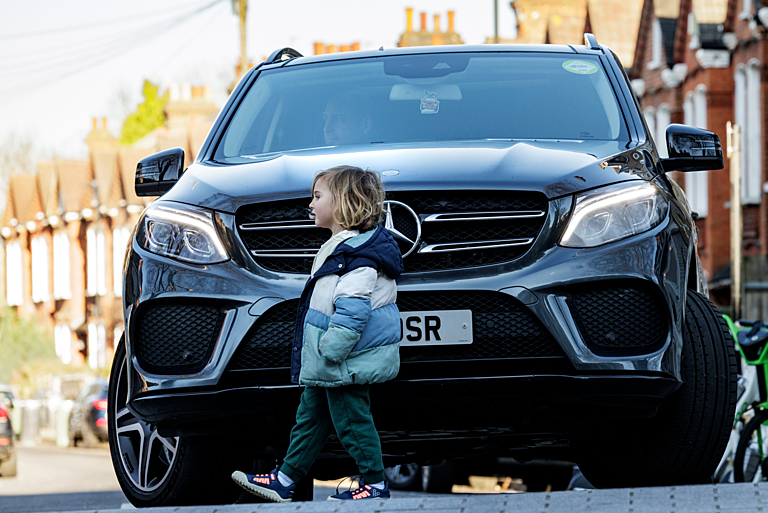
“These vehicles tower over children, buggies and dogs…That’s why these trucks have no place on our city streets.”
Some advert campaigns have powerfully illustrated how these vehicles tower over children, buggies and dogs. A child could run out in front of the bonnet of a truck, and, to the driver, be completely invisible.
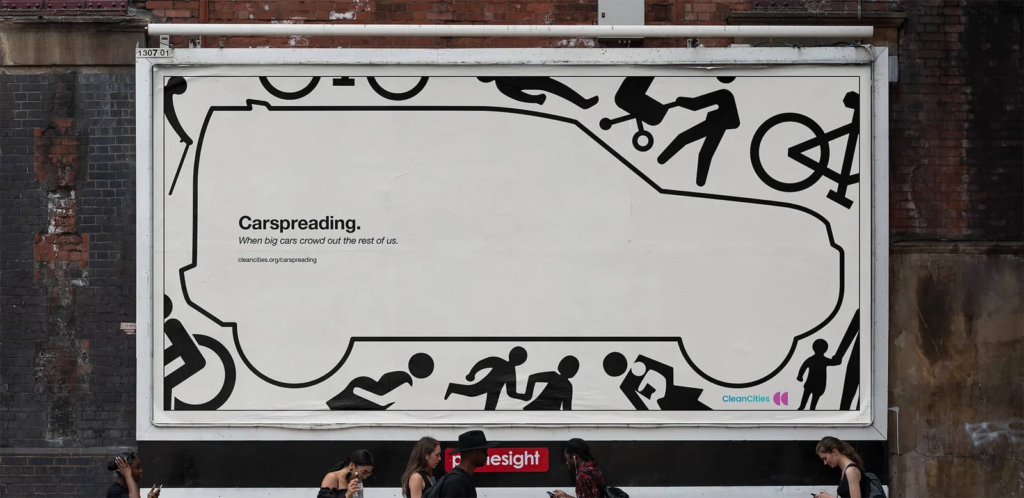
Find out more about the phenomenon of Carspreading here.
That’s why these trucks have no place on our city streets, especially for those who mostly drove them for personal use under the previous tax arrangements.
“This shows that the government can make progressive change, and challenge the UK’s car-dominant culture, without causing a huge fanfare.”
It may be a coincidence, but there appear – anecdotally, at least – to be far fewer pick-up trucks on city streets in the last couple of months. And a U-turn on this new policy is very unlikely. It shows that the government can make progressive change, and challenge the UK’s car-dominant culture, without causing a huge fanfare.
However, these trucks are still on our roads. They are not prohibited from driving into the Low Emission Zone in any Scottish city, even though their engine is much larger than most cars and they pose a higher risk than many other vehicles.
And there is far more progress we’d like to see in Scotland.
We want to see the Scottish Government commit to tackling the rise of SUVs (sports utility vehicles) in our cities and urban areas.
These cars are bigger, heavier, more polluting, more dangerous, and they dominate our streets at the expense of safer, fairer travel for everyone else.
We’re also calling for more investment in public transport, rather than roads, an increase in fuel duty, and a workplace parking levy and / or congestion charge.
We know that air pollution kills thousands of people in the UK every year – far more than heatwaves, or even the covid pandemic.
We need to raise taxes from those who, as Labour says, have the broadest shoulders.
For a range of progressive ideas around policy and tax from subject matter experts, see our report, Ideas for Investment, published in November 2024.